


If you’re an outfitter holding a special use permit on National Forest or BLM ground, you already know the cycle: operating plan before the season, itineraries ahead of the trips, actual use report after it's over, fee built on the numbers. Nobody needs to explain any of that to you — you've been filing it for years, and if it were up to you, none of it would exist.
What HuntDocs changes is how much of your time it takes. The facts every one of those filings asks for — which client, which days, which ground, which guide — get captured once, inside work you're already doing, and the reports fall out of them. You never sit down to "do the records." The records are a side effect of running the operation.
Here's how that works, piece by piece.
The booking already holds the facts
Client, dates, guide, fees, GMU — entered once when the hunt is booked, because you need them to run the trip anyway. That same record is what every filing draws from later. Nothing gets typed twice: the details that used to be retyped before every trip for the itinerary — name, city and state, phone, GMU, fees, hunting or non-hunting, plus the guides and vehicles — are already sitting on the booking.
Your ground is set up once
The areas you operate on — National Forest, BLM, state trust, private — are typed in one time. After that, every booking carries the days it used on each area: a forecast when you plan it, an actual when it's done. A five-day hunt where the party spent two days on one unit and three on another is two records, not one — captured in seconds, during the season, by the person who knows the answer. That single habit is the entire input. Everything the agencies ask for is built from it.
No trip closes with actual use days missing
A trip can't be closed out while it has a forecast on Forest Service or BLM land and no actual recorded against it. That one rule is what makes the season's record complete without anyone policing it. The number gets captured while the trip is fresh, by the guide who ran it — including the extra day, the unit change, and the half-day that the handbook counts as a full service day and memory never does. The facts a guide would have carried around in his head get written down before the trip is done, and nobody has to chase him in the off-season.
That matters beyond convenience, because reconstruction always runs low: the forgotten half-days, the observer who rode along and counts as a client, the day that lived in a guide's head. Every one of those shrinks the documented use your permit's allocation and renewal are built on. Days that never made the record are days you can't point to when it counts.
The actual use report is a screen, not a stretch of your off-season
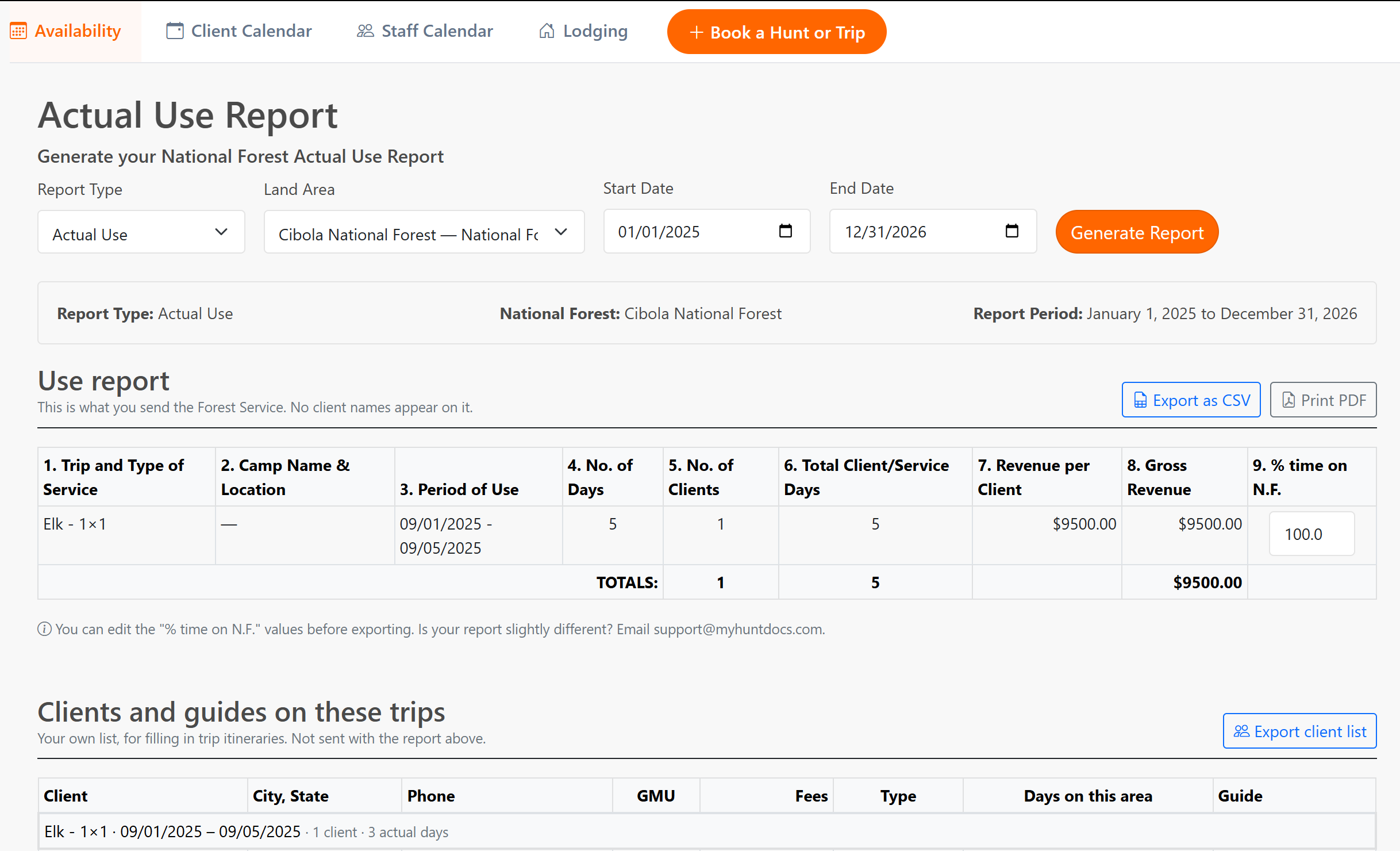
Pick an area and a date range, choose forecasted or actual, and read it: days, clients, client days, revenue per client, gross revenue, and the percentage on forest — calculated as client days over total client days so the column adds up. A trip across two forests reports to each forest what happened on that forest. Cancelled bookings never count. Observers count as clients but carry no revenue, matching how the form treats non-paying companions. Export to a spreadsheet or a PDF and transcribe onto the form your unit uses.
The same numbers feed the fee. Whichever method was set when your permit was approved, both options in the handbook run on client days and the off-forest share — so the figures behind what you pay come off records made during the season, not rebuilt from memory after it.
The names are already assembled
Behind every row of the report is the client list — names, cities and states, phones, GMUs, fees, hunting or observing, days on that unit, and the guides who covered them. When a district asks which eleven clients were behind the fourteen days, the answer is an export, not an evening of opening hunts one at a time. It's most of what an itinerary asks for in one file — and it's deliberately kept out of the agency exports, because the actual use report has no client-name column and there's no reason to hand an agency a field it didn't ask for.
The itinerary itself is worth filing where you can find it: some forests' actual use reports treat the trip itinerary as the document backing where a trip actually went — which makes the itinerary you already send the record standing behind the off-forest time you claim later.
Everything in one place, every year
Every hunt and everything attached to it — the clients, the days, the areas, the guides, the money — lives in one place, season after season. Not this year's spreadsheet and last year's in a different file, not paper copies split between a drawer at the house and a filing cabinet at the office. One system, always available, whether the question is about a trip next month or a season three years back.
The permit paperwork lives there too. Upload your special use permits, operating plans, trip plans, guide and vehicle lists, insurance certificates, lease agreements, and past filings — each filed to the area it belongs to, with the year it covers and the date it expires, so the insurance certificate stops being the document nobody's watching. Guides get the documents that apply to them instead of the whole folder.
You see it during the season, not after
Forecast days against actual days across your permitted areas, on your dashboard, while there's still time to do something about the gap. Every entry carries who recorded it and when — so a number a district asks about has a trail behind it, not a shrug.
The operating plan side is personnel and vehicle tables in the shape the agencies ask for, exportable — not yet filtered per forest, so the per-unit roster is still something you assemble.
What it does is make sure the facts exist — recorded once, per client, per area, per guide, when they happened — so every filing is transcription instead of reconstruction, and the whole obligation takes the least time it possibly can.
Common questions
What records do you need for a Forest Service actual use report?
Days used, per client, per area — captured as the season goes rather than assembled from it. Everything the form asks for is built from that one figure. If the per-client per-area day count exists, the report is addition. If it doesn’t, the report is an estimate with a signature on it.
We already track this in a spreadsheet. What's different?
A spreadsheet holds the numbers fine. Two things it doesn't do: notice that a completed trip never got its actual days recorded, and keep the client detail attached to the number so you can produce names when you're asked for them. Most spreadsheet failures aren't arithmetic — they're a row nobody filled in. And a row nobody filled in is use that isn't in your history, anywhere.
What if a guide, not the office, knows what actually happened?
That's usually the case, which is why the close-out check matters. The trip can't be finished with the actual missing, so it gets asked about while the person who was on the mountain still remembers — including the extra day, the unit change, and the half-day that counts as a full one.
How do you count days when only part of a day was on forest?
Forms differ on the exact rule — some count any fraction of a day on forest as a full day — so the record has to be finer than the rule. Because days are recorded per client per area as they happen, the split is already in the record, and whichever way your form counts, the number comes off what was written down during the season instead of an estimate afterward.
When does a trip start and end for reporting?
That also varies by form — some count from the day the client comes under your care, on or off forest. The booking carries the trip dates and the per-area days separately, so however your form defines the trip, both numbers exist and neither has to be reconstructed.
What backs up the off-forest time on the report?
When a form asks for justification of time off federal ground, it usually wants a breakdown or a document trail. Days recorded per area, per client, during the season — with who recorded them and when — are that trail, and the itinerary filed against the trip corroborates it.
We hold permits on four units. Does that get messy?
Each area is its own record, and each booking can carry days on more than one. The report is run per area, so four units is four reports off the same underlying data rather than four separate record-keeping systems.
How far back does it go?
Records stay attached to the bookings and the areas, so prior seasons remain readable — which matters when a district asks about a year you've already filed, when your operating plan needs last year's actual figures, or when a renewal conversation turns to your use history.
The paperwork owed by clients rather than to agencies is its own job — that's covered in tracking what's outstanding before a trip. And if you also run a shooting preserve, the state requirements are their own tangle.
Forest Service references were read from published Forest Service sources in July 2026. Requirements and deadlines vary by unit and change; confirm anything here with your own district. General information, not legal advice.