

Every state that licenses shooting preserves requires you to keep records. What varies is nearly everything else: which records, in what format, on whose forms, by when, and what happens if the paperwork is late. An operator in Ohio has to band birds before they go out. An operator in South Dakota has to tag them after they come in. An operator in Wisconsin can lose a renewal for missing a deadline by ten days. None of those three states publishes anything about the other two.
This is a plain-English guide to what states commonly require, with twelve worked examples showing where the requirements diverge. It is general information, not legal advice, and it is not a substitute for your own state's current rules. Preserve regulations get amended regularly. Confirm anything here with your licensing agency before you build a season around it.
The four records nearly every state asks for
A daily record of birds released
This is the record everything else hangs on. Where a state caps your allowable harvest, it sets the cap as a share of the birds you released, per species — so the release record is what makes the harvest lawful. Species, count, and date are the minimum. Recording which field or unit the birds went into is rarely required, but it is the thing that makes the harvest side defensible and the thing that tells you whether a field is worth releasing into again.
That share is not the same everywhere, and assuming it is 100 percent is the most expensive mistake in this article. Kansas allows 100 percent of the number of each species released. Minnesota allows less: at a private shooting preserve, the number of pheasants harvested may not exceed 95 percent of the number released. Idaho, which is not in the table below, allows less again — the total taken in a season "shall not exceed eighty-five per cent (85%) of the total number of the individual species of said birds released" (Idaho Code 36-2208). And Virginia sets no departmental bag limit on game birds at all. Four states, four different answers. Find yours before the season, not during it.
Timing is where operators get tripped up, because several states treat the release record as a precondition rather than a summary. Michigan is the clearest case: before any birds are taken, the operator must certify to the DNR the number of each species released and the date of release, and then obtain the identification tags. South Dakota requires harvest and release records be maintained and recorded daily through the whole season. Wisconsin spells out the fields: a daily record of the date of activity, the number of birds stocked by species, and the number killed or harvested by species.
A record of birds harvested
The harvest record proves you stayed under the cap. Kansas states its cap directly — the licensee "shall not take or permit the taking of more than 100 percent of the number of each species of game bird released on the controlled shooting area", a species cannot be hunted at all until a release of that species has been made, and only birds released between August 15 and April 30 count toward the allowable take. South Dakota applies the same ceiling but counts wild birds against it too, which surprises people. Minnesota's ceiling sits lower, at 95 percent of released pheasants for a private preserve.
Whatever form it takes, your harvest numbers and your release numbers have to be readable against each other by species. A harvest total that exceeds a release total is a violation on the face of the document, and it is the first thing an officer looking at your books will notice.
A register of everyone who hunts
Most states call it a hunter register. Virginia's permit conditions are the most prescriptive of the twelve: name, address, and hunting license number of every person who hunts whether or not they took anything, the dates hunted, the number of each species taken, and the tag or band numbers placed on the game — retained for at least two years, open to inspection at any reasonable time.
Other states word it almost identically. Minnesota requires "the names, addresses, and hunting license numbers, if applicable, of all hunters, the date when they hunted, the amount and species of game taken, and the tag numbers or other markings affixed to each bird". Idaho asks for the same list and adds a detail worth noticing — the game taken recorded "by sex and species", plus the band numbers affixed to each carcass. If you keep one register that satisfies Virginia, Minnesota, and Idaho at once, you are keeping a register that satisfies most of the country.
The register isn't only for the agency. In South Dakota, a client carrying more than the standard number of tagged pheasants is lawful if they can document multiple days of hunting on the operator's guest register. Your record keeping is what protects their possession on the drive home.
An annual or end-of-season report
The summary you send the agency. Birds released by species, birds taken by species, usually a count of how many people hunted. Virginia spells out all three: a report "summarizing the total number of individuals hunting, a total of each species released, and a total of each species taken".
The deadline is set by the state and frequently lands nowhere near the end of your season — Minnesota wants it March 15, Iowa April 30, Indiana May 10, Nebraska before May 15, Virginia May 30, Michigan July 15, Kansas August 1.
How states differ
Four variations actually change how you run the operation: whether the state supplies numbered kill tags, whether birds must be marked or banded before they are released, whether there is a release minimum, and when the report is due.
| State | Tags on birds taken | Marking before release | Release minimum | Report deadline |
|---|---|---|---|---|
| South Dakota | GFP serial-numbered kill tag on every bird taken on preserve acres, released or wild; 25¢ per tag used | Pheasants toe-clipped or marked by enlarged nares before six weeks of age; a department representative verifies marking and release | 300 rooster pheasants first year, 600 each season after; hens don't count | Records kept daily in a GFP-provided online system |
| Kansas | Per regulation; confirm with KDWP | Not specified for upland species | Take capped at 100% released; only birds released Aug 15–Apr 30 count | Final report with the renewal application, or Aug 1 if not renewing |
| Minnesota | Self-sealing tag purchased from the commissioner, identifying the preserve | Released ring-necked pheasants identifiable by a clipped outer toe of the right foot, evidence of blinders, or debeaking | Private preserves may release no more than 300 adult pheasants in a season and may not harvest more than 95% of what they released; commercial preserves must release at least 1,000 | March 15, for the preceding calendar year |
| North Carolina | Written record of each hunter, executed in duplicate; the original goes to the client as a receipt for birds harvested, the duplicate is held 12 months after the hunt | Not specified | Not specified | Postmarked within 15 days after the permit expires June 30 |
| Michigan | Identification tags obtained from the DNR, affixed to every bird shot | DNR may require marking or leg bands before release; bands furnished by the director | Birds released at least two weeks before opening may be taken up to the number released | Annual report and a notarized copy of records by July 15; DNR may also require monthly reports |
| Virginia | Serially numbered tag or band bearing the preserve number on every bird or package | Quail released during the May–August dog training season must be tagged or banded first | No department bag limit; five birds per dog per day in training season | May 30, within 30 days of the season ending April 30 |
| Pennsylvania | Consecutively numbered tags supplied by the commission; the right foot may not be removed until the tag is attached | Not specified | At least 100 of each species listed on the permit | Birds killed during dog training count toward the reported kill; confirm timing with PGC |
| Iowa | Numbered self-adhesive leg tag on every bird before it is transported off the licensed area; stays on until processed for consumption | Not specified | Not specified | April 30 of the license year, on department forms |
| Indiana | Confirm with DNR | Not specified | Not specified | May 10, on State Form 15003, broken out month by month from September through April |
| Nebraska | Confirm with Game and Parks | Not specified | At least 500 birds between the date the permit is issued and April 15 — a total, not per species | Records for July 1–April 15 submitted to Lincoln before May 15, on commission forms |
| Wisconsin | Confirm with DNR | Stocked birds must be fully feathered and at least 12 weeks old | Not specified | Renewal blocked if records aren't submitted by deadline or within 10 days of a request |
| Ohio | Tag or seal supplied by the division for any bird taken off the licensed area | Every game bird leg-banded with a band identifying the preserve before release | 500 pheasants annually, or an approved substitute species | Confirm with the Division of Wildlife |
Where a cell says "confirm," the requirement exists but the published text wasn't specific enough to state plainly here. That is deliberate. It is better to send you to the agency than to print a number you might rely on.
Twelve states is most of the commercial preserve business in the country, but it is not all fifty. If yours isn't listed, search your state wildlife agency's site for "shooting preserve," "controlled shooting area," "regulated hunting grounds," or "hunting preserve" — the license goes by a different name in almost every state, which is part of why this information is so hard to find.
Two things that catch operators
Your spreadsheet may not be an accepted format
A lot of states require records and reports on their own paperwork. Kansas requires records be maintained on forms provided by the department. Minnesota requires the annual report on a form provided by the commissioner. Iowa requires an annual activity report on department forms by April 30. Nebraska requires records "on record forms provided for this purpose by the Game and Parks Commission". Indiana's report is State Form 15003, a month-by-month grid. Michigan can require a notarized copy of your records. South Dakota gives operators access to an online system and expects it used.
Keep your own records regardless — you need the operating data to run the business. But do not assume the format you keep them in is the format the agency will take. That is a question to ask in August, not in April.
The license may not renew until the report is in
Kansas puts it in the regulation: a controlled shooting area license shall not be issued or renewed until the department has received a final report. Wisconsin lists the bird hunting preserve license among those that may not be renewed when a licensee fails without good cause to submit required records by the deadline, or within ten days of a request for them. North Carolina makes reporting the number released, the species, and the county part of the renewal itself.
A late report in those states doesn't produce a fine. It produces a preserve that cannot legally open.
What good record keeping looks like day to day
The single highest-value habit is writing the release down at the crate, in the moment. Species, count, date, field. Not reconstructed in April from game farm invoices and memory, which is how most operators do it and how most discrepancies get created. Minnesota's standard — current within 48 hours, retained three years — is a reasonable one to hold yourself to anywhere, whether or not your state says so.
Track harvest against release per field, not just per season. A running recovery rate tells you where the birds are holding, how many to order next time, and roughly where you sit against your state's cap before you back into it. Operators who only look at the season total find out about a problem after it has already happened — and if your state's cap is 85 or 95 percent rather than 100, you will cross it earlier than instinct says you should.
Record the band or tag numbers individually, against the person who took the birds. Virginia, Minnesota, and Idaho all ask for the numbers on the game, not a range you wrote down at the end of the day — and on a field with three hunters the bands interleave, so a range recorded per person is wrong the moment more than one gun is out.
Hold the game farm's purchase and delivery invoices. Iowa requires it outright — licensed preserves "shall retain sales/shipping receipts involving the purchase and delivery of any game birds or ungulates to the licensee", and original sales receipts for harvested birds stay with the licensee as a permanent record. Everywhere else they corroborate your release counts and establish that the birds came from a legal source. In states with poultry health requirements they are also the proof that the flock was tested — Iowa, for instance, requires proof the flock came from a pullorum-typhoid clean rating under the National Poultry Improvement Plan.
Two smaller things. Reconcile the register weekly — chasing a missing address or license number is easy the same week and miserable the following spring. And know your retention period: Virginia says two years, North Carolina says twelve months for harvest receipts, Minnesota says three years. If you operate in more than one state, keep everything for three years and stop tracking it separately.
Where HuntDocs fits
HuntDocs can hold these records for you, and it is built around the four the states actually ask for.
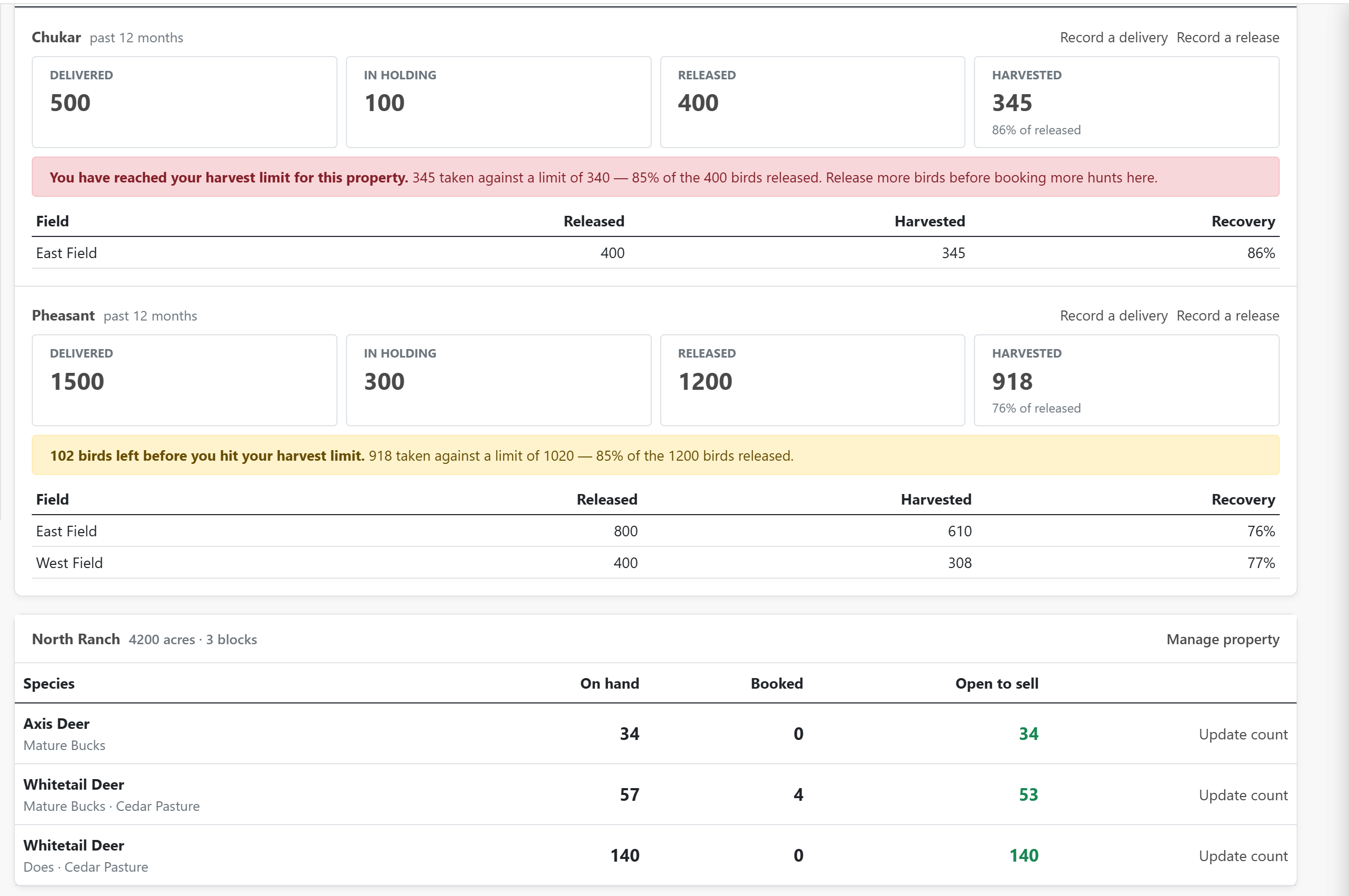
Releases and harvests. Deliveries from the game farm, birds held, birds released into a named field, and birds taken — each recorded as it happens, with recovery rate per field season to date. The game farm's invoice attaches to the delivery it paid for, so the paperwork that corroborates your release counts is filed with the counts themselves.
Your harvest limit. Because the cap is 85 percent in one state and 100 in another and nonexistent in a third, HuntDocs doesn't assume one. You enter the percentage your state allows, and it warns you as the harvest approaches that number and again when you reach it, with the arithmetic shown. Leave it blank and you are still told if harvest ever reaches the number of birds you released.
The hunter register. Everyone who hunted in a date range — including the people who went home empty-handed, who are the easiest to leave off a handwritten page — with their address, hunting license number, dates, what they took by species and sex, and the band or tag numbers. Ranges typed in for speed are stored as individual numbers, so each one reads against the person who took it.
The annual summary. Season totals in the shape agencies ask for them: how many individuals hunted, and how many of each species you brought in, released, and took.
All of it exports as a spreadsheet or a printable file. What HuntDocs does not do is file anything with a state agency on your behalf, and it does not by itself satisfy a state's form or format requirement — several states will only accept their own paperwork, and a few want it notarized. The records are yours to keep and yours to file. HuntDocs makes sure they exist, and that they are accurate, when you need them.
Common questions
Do I need a license to release pheasants on my own property?
Usually, if people are paying to hunt them or you're hunting them outside the regular season. The license goes by different names — private shooting preserve permit in South Dakota, controlled shooting area license in Kansas and Nebraska, regulated hunting grounds permit in Pennsylvania, bird hunting preserve license in Wisconsin, commercial bird shooting preserve license in Ohio. Acreage minimums are near-universal and range widely: 40 contiguous acres in Wisconsin, 80 in Ohio, 80 in Nebraska, 100 in Pennsylvania, 100 in North Carolina, 100 in Virginia, and 160 in South Dakota. Minnesota is the one to read carefully, because the number depends on which license you hold: a private preserve needs at least 40 acres, a commercial one at least 100. Several states cap the maximum too — Ohio at 640 acres, Wisconsin at 640, Minnesota at 160 private and 1,000 commercial, Nebraska at 2,560. A few, including Iowa, also allow a landowner to release pen-reared pheasants on their own land under a narrower exception.
How long do I have to keep the records?
One to three years depending on the state. Minnesota requires three years following the year of creation. Virginia requires at least two. North Carolina requires the duplicate harvest record be held twelve months after the date of the hunt. Iowa treats original sales receipts for harvested birds as a permanent record. Keeping everything three years covers nearly every case.
What happens if I miss the annual report deadline?
In several states the consequence isn't a citation, it's a renewal that doesn't happen. Kansas will not issue or renew a license without the final report. Wisconsin can block renewal for records not submitted within ten days of a request. Treat the deadline the way you'd treat a tax filing and put it on the off-season calendar the day the season closes.
Do I have to tag birds my clients take home?
In most of these states, yes, using a tag the agency issues or approves. South Dakota issues serial-numbered kill tags and charges 25 cents each. Michigan requires identification tags obtained from the DNR. Minnesota requires a self-sealing tag bought from the commissioner. Pennsylvania supplies consecutively numbered tags and prohibits removing a bird's right foot until the tag is on. Virginia requires a serially numbered tag or band carrying your preserve number. Iowa requires a numbered self-adhesive leg tag before the bird leaves the property, sold by the DNR at $5 per hundred. Ohio requires a tag or seal supplied by the division for any bird possessed or transported outside the licensed area. The tag generally has to stay attached until the bird is prepared for consumption, and telling your clients that is your responsibility, not theirs.
Do birds have to be banded before they're released?
In some states, yes, and it's a different requirement from tagging birds that were taken. Ohio is explicit: "All game birds released on a licensed commercial bird shooting preserve shall first be banded with a leg band that shall bear upon it a symbol identifying the commercial bird shooting preserve." South Dakota requires pheasants be marked by toe clipping or enlarged nares before six weeks of age, verified by a department representative. Minnesota requires released pheasants be identifiable by a clipped outer toe, blinder evidence, or debeaking. Michigan authorizes the DNR to require marking or banding before release. If you buy birds from a game farm, this is worth settling with them before delivery rather than after.
Can I count wild birds taken on the preserve?
Sometimes you must. South Dakota requires every bird taken on preserve acres be tagged, wild or released, and counts both against the release total. Other states treat wild birds separately or ignore them. Getting this wrong distorts the numbers you report in either direction, so confirm it directly rather than assuming.
Requirements described here were verified against official state sources in July 2026. Regulations change; confirm your own state's current rules with the licensing agency before relying on anything above.